Enterprise orchestration built for hybrid cloud
Manage workloads, applications and IT infrastructure across public cloud, private cloud and on-premises environments from a single control plane. Get the visibility and scalability you need without adding complexity.
Drive transformation at the lowest total cost of ownership
Modernize your enterprise with cloud-first, SaaS architecture that supports AI initiatives and eliminates technical debt across hybrid cloud environments.
-

Enterprise-grade SaaS
A proven SaaS platform with 99.95% uptime and enterprise-scale reliability
-

Open connectivity
No-code and API-based integrations across cloud providers, enterprise applications and data platforms
-

Agentless architecture
Faster deployment, simpler operations and effortless upgrades — no agents or infrastructure to maintain
-

AI-powered automation lifecycle
Embedded AI supporting workflow design, monitoring, optimization and remediation
-

A two-time SOAP Leader
Two consecutive years as a Leader in the Gartner® Magic Quadrant™ for Service Orchestration and Automation Platforms (SOAP)
-

Robust hybrid cloud integrations
Out-of-the-box application, data and cloud services integrations, plus flexible connector creation
After cloud migration: The path to modernization
Hybrid cloud adoption often begins when organizations expand their use of cloud computing through migration projects. But moving workloads is only the first step — what comes next depends on how well those environments are coordinated.
A modern hybrid cloud orchestration platform coordinates workloads across legacy systems, cloud infrastructure and cloud-native applications. It acts as an orchestration layer, simplifying lift-and-shift environments while supporting gradual modernization.
With this approach, you can adopt new technologies faster, reduce operational risk and optimize total cost of ownership (TCO) across complex hybrid environments.
The realities of managing hybrid cloud environments
Hybrid cloud enables flexibility and innovation, but it also increases operational complexity as organizations manage workloads across distributed environments.
-

Slow modernization
Many enterprises still rely on legacy schedulers, scripts and disconnected automation tools that weren’t built for hybrid or multi-cloud environments. Adopting cloud services and modern applications can make automation fragmented, and coordinating workflows across systems can become slow and difficult.
-
Limited visibility
Hybrid environments span multiple cloud providers, applications and infrastructure platforms. Without centralized orchestration, teams struggle to see how systems depend on each other, making incidents harder to diagnose and service levels harder to maintain.
-
Rising cloud costs and inefficient resource usage
Lift-and-shift migrations often move workloads to the cloud without optimizing how they run. This leads to over-provisioned resources, inefficient cloud usage and rising costs.
-
Refactoring and migration risk
Running legacy systems alongside modern cloud-native applications introduces risk if workflows aren’t coordinated. A hybrid cloud orchestration platform helps ensure workloads run reliably across both environments as modernization progresses.
A unified platform for hybrid cloud orchestration
RunMyJobs by Redwood provides enterprise orchestration for hybrid environments, helping teams coordinate complex workflows while adapting to changes in cloud architecture and reducing operational overhead.
Dynamic, cross-cloud orchestration
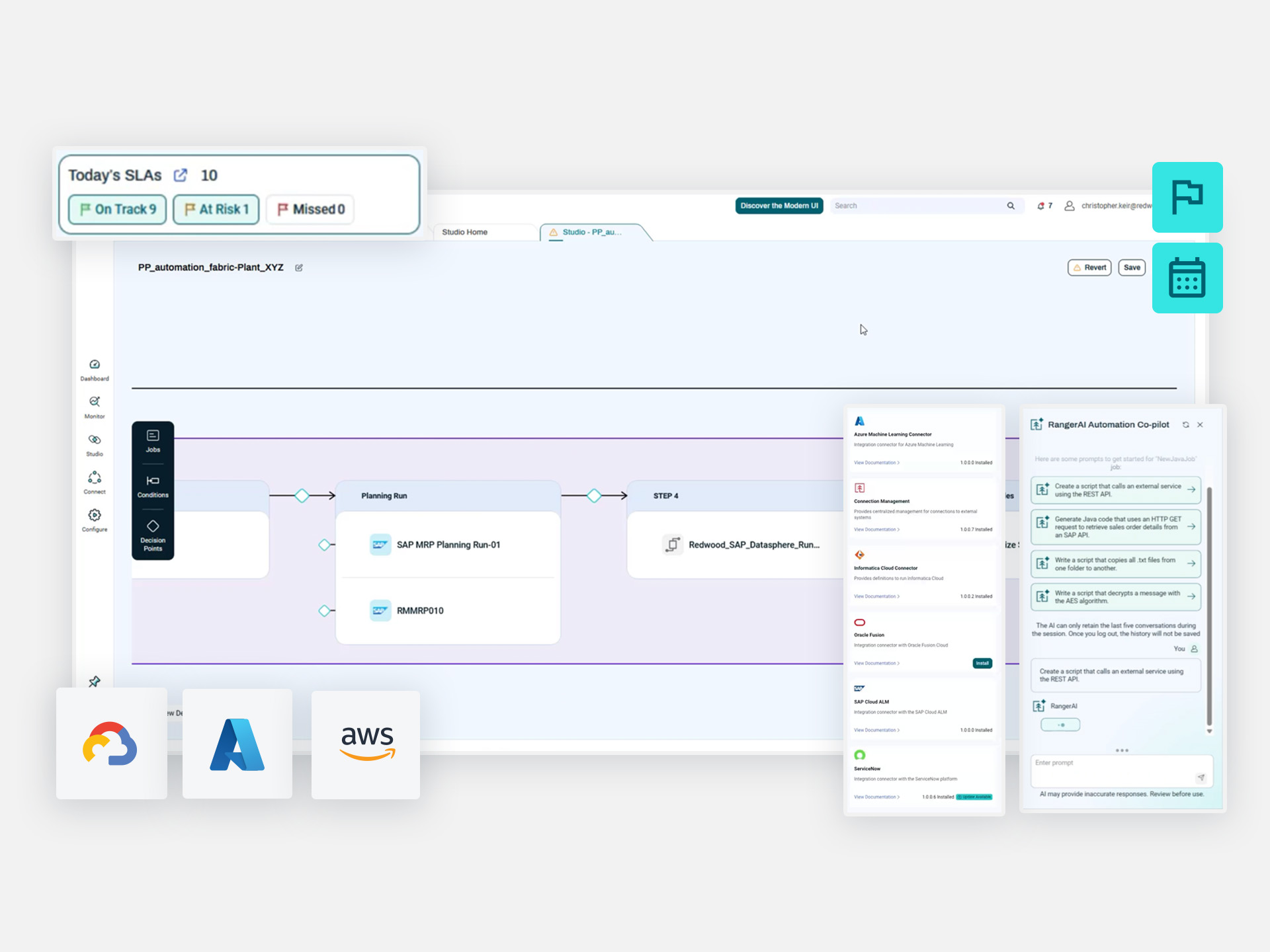
Bring legacy on-premises and cloud workflows together and run them as one, with clear visibility into performance and SLA health.
With RunMyJobs, you get:
- A rich hyperscaler connector catalog
- An AI-embedded, no-code designer
- Calendar- and event-driven workflows
AI across the entire automation lifecycle
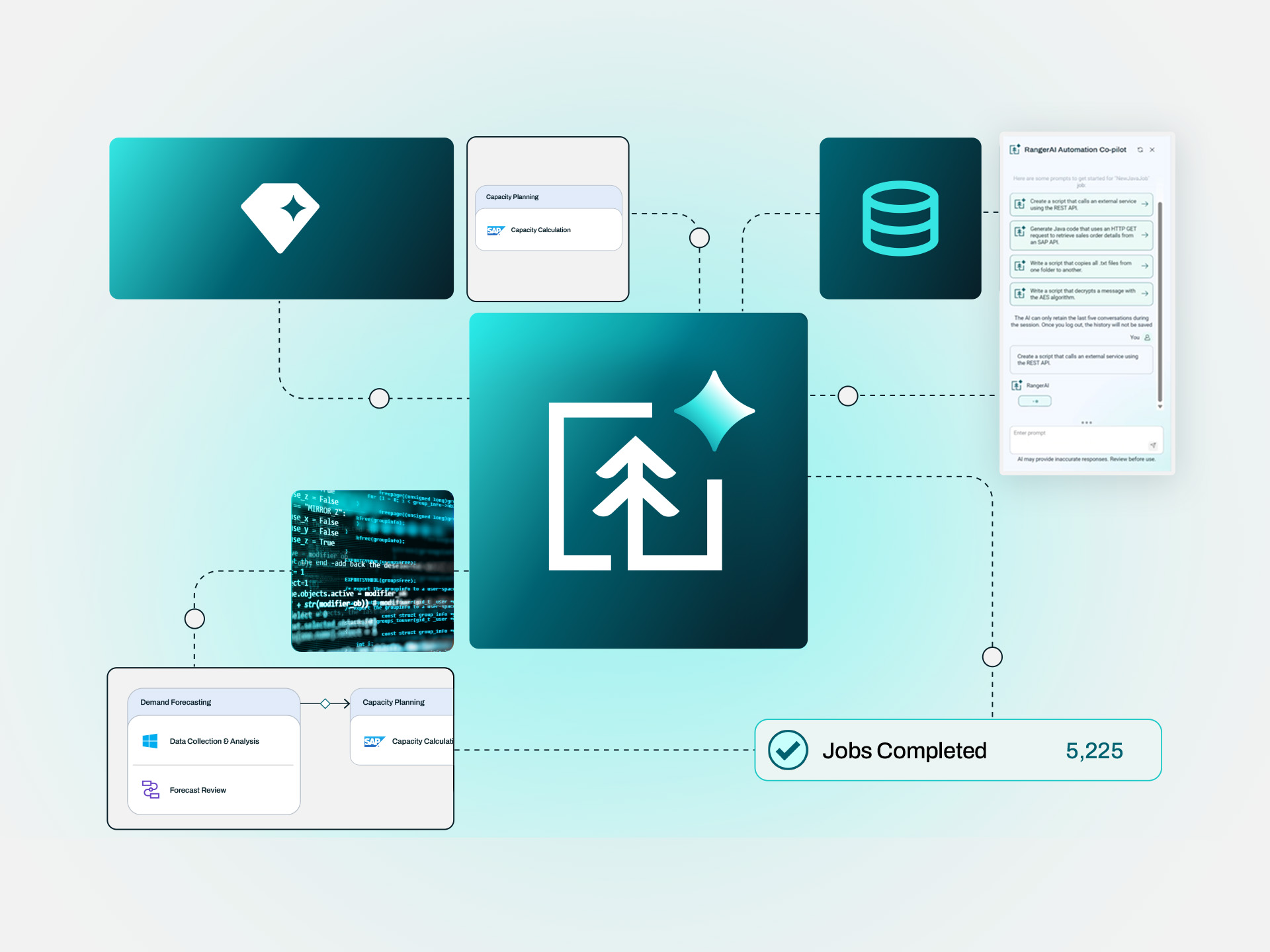
AI is embedded at every stage, from workflow design assistance and performance and anomaly detection to predictive SLA monitoring and automated remediation. Redwood RangerAI and Redwood Insights give teams proactive control before incidents reach production.
- AI-assisted troubleshooting
- Automated remediation
- Predictive SLA monitoring
Full-scale, zero-maintenance SaaS orchestration
With no agents to install, patch or maintain, RunMyJobs’ Secure Gateway deploys immediately, bridging cloud and on-premises environments without creating infrastructure debt. Upgrades happen with zero downtime.
-

99.95% SLA uptime
-
Agentless architecture
-
Secure gateway
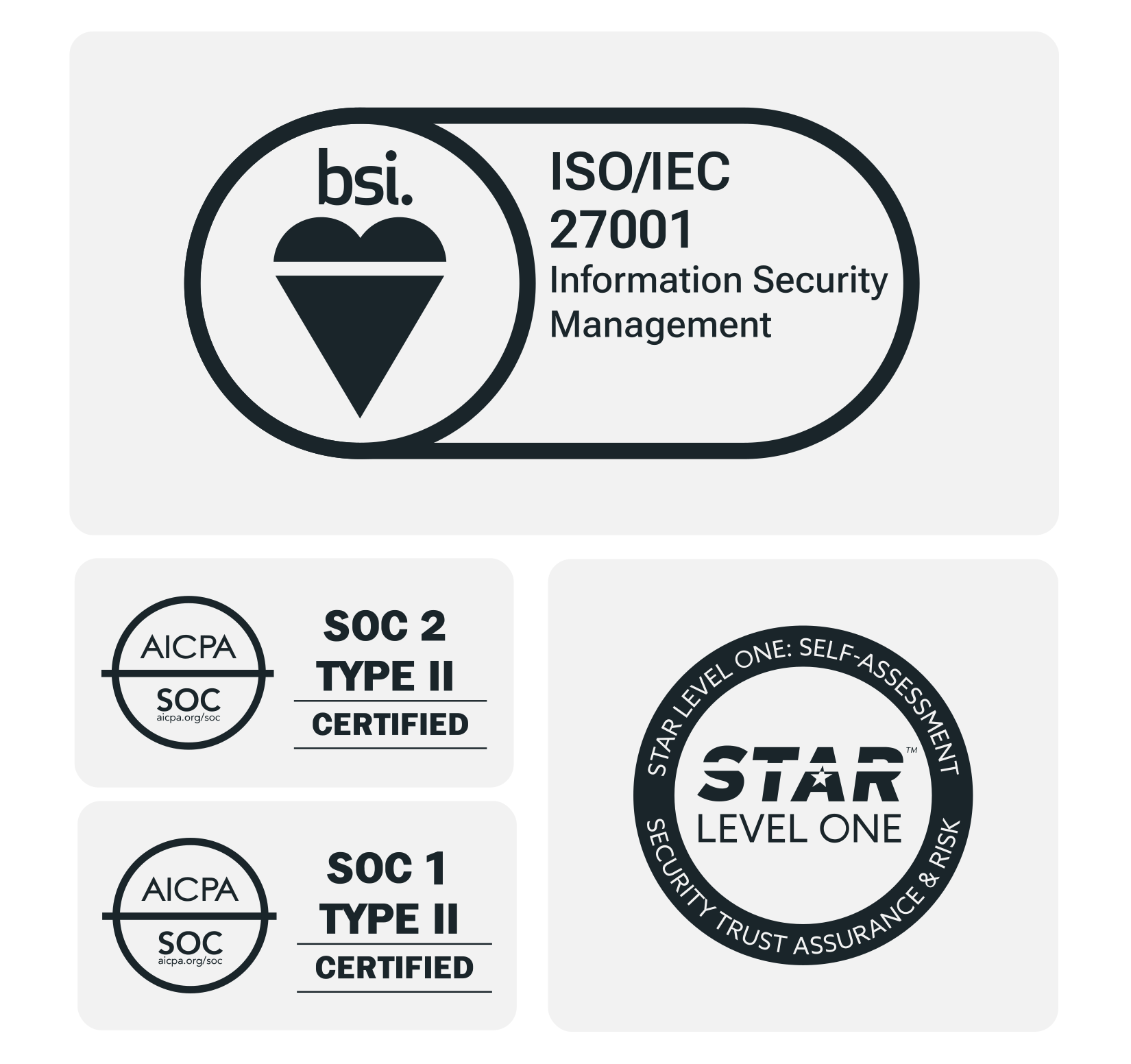
Enterprise-grade governance and security
Manage access, auditing, compliance and data protection from one place across your hybrid environment. No need to stitch together separate governance tools for each cloud platform.
- Centralized administration
- Global reach and sovereignty
- Role-based access control (RBAC) and role-specific dashboards
Use cases that deliver results
Explore how organizations orchestrate workloads, modernize operations and improve reliability across hybrid environments.
-
Observability across hybrid cloud
Experience True ObservabilityGain deep visibility into workflow performance, dependencies and SLA health across distributed environments.
-
Data pipeline orchestration
Orchestrate DataAutomate data ingestion, processing and delivery across hybrid environments to keep analytics and business systems running on schedule.
-
SAP and ERP integration
Connect SAPCoordinate workflows across SAP, ERP systems and cloud applications to ensure business processes run reliably across your hybrid landscape.
-
Self-service automation
Empower Business UsersEnable teams to launch and manage workflows through standardized automation services without relying on manual operations.
-
Event-driven automation
Trigger WorkflowsTrigger workflows automatically in response to application events, system updates or cloud activity across hybrid environments.
-
DevOps orchestration
Accelerate DevOpsRun CI/CD workflows across hybrid environments so releases move faster and stay consistent across systems.
How teams run hybrid cloud operations with RunMyJobs
RunMyJobs brings workflows, systems and teams together so you can manage hybrid cloud operations in a more consistent, predictable way.
-

Connect
Experience True ObservabilityIntegrate your hybrid cloud environment using pre-built integrations (AWS, Microsoft Azure, SAP, Oracle, data platforms, ITSM tools), no-code connectivity and the agentless Secure Gateway.
-

Orchestrate
Orchestrate DataDefine, schedule and execute workflows across cloud deployments and hybrid environments from a no-code visual workflow studio. AI-powered dependency management handles cross-platform coordination automatically.
-

Optimize
Connect SAPMonitor SLA performance in real time, receive predictive alerts before failures occur and trigger automated remediation. Redwood Insights gives you continuous visibility into automation health, cloud spending and cost optimization.
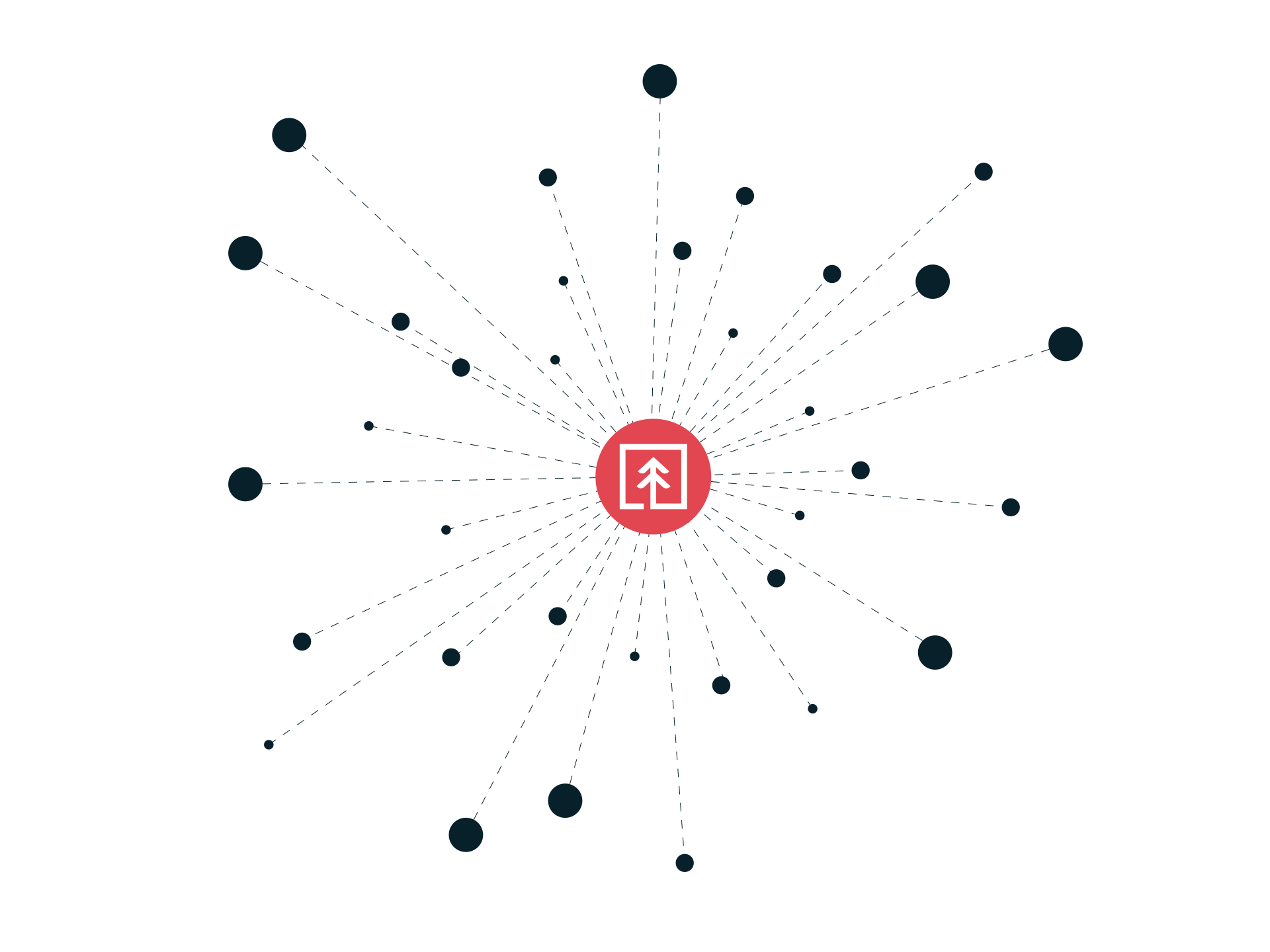
Connect your hybrid ecosystem
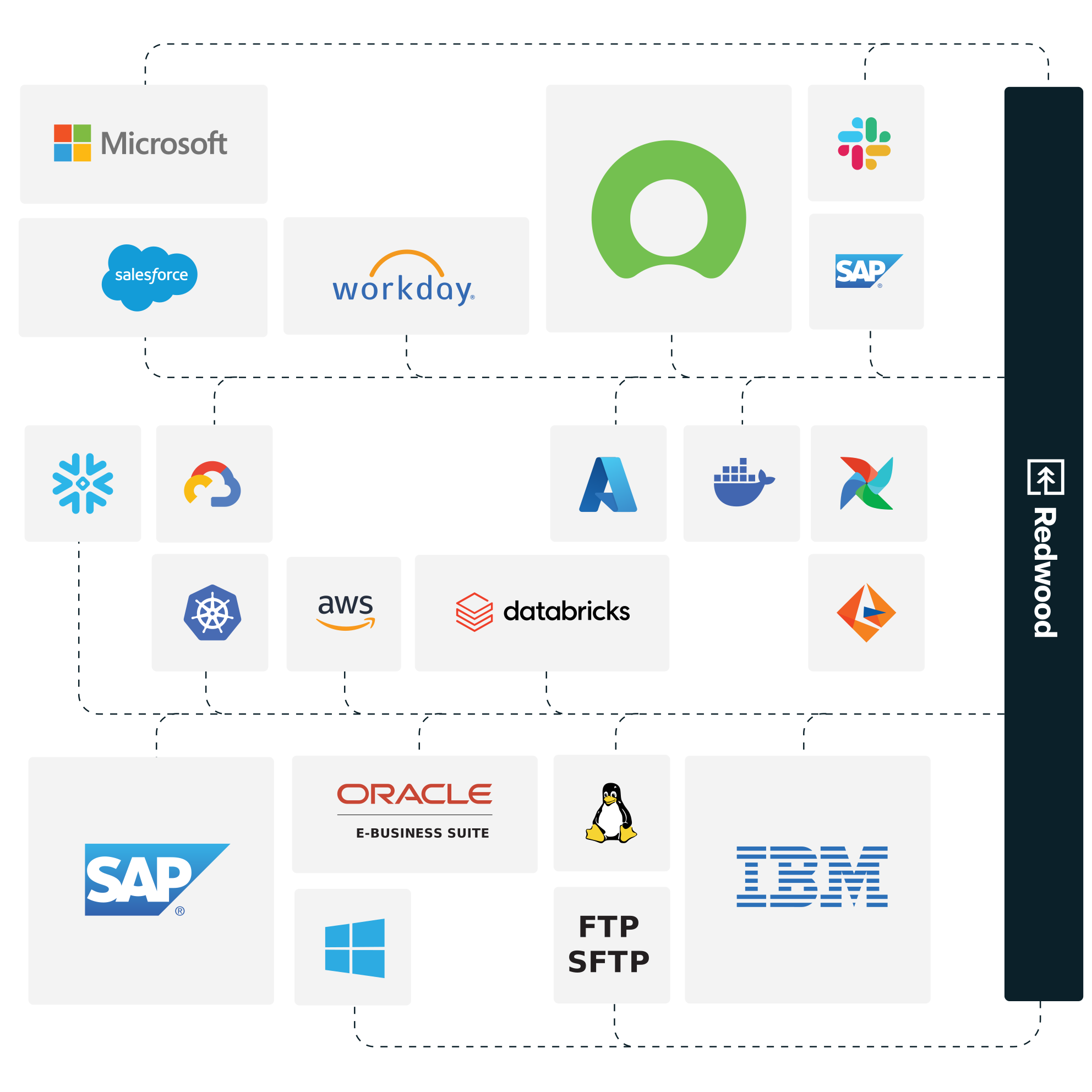
RunMyJobs integrates with 500+ technologies across your hybrid estate, from hyperscalers and ERPs to data platforms, ITSM tools and observability solutions.
- AI and machine learning
- Business intelligence
- Data management
- ERP
- Monitoring and observability
- Service management
It’s also available on AWS Marketplace for simplified procurement and deployment.
Why enterprises replace legacy workload automation tools
Legacy workload automation (WLA) tools add overhead, limit scalability and drive up costs. Moving to a cloud-first, agentless SOAP like RunMyJobs reduces that burden and makes it easier to scale and modernize operations.
More cloud orchestration insights
Get practical perspectives on hybrid cloud modernization.


Hybrid cloud orchestration FAQs
What is hybrid cloud management?
Hybrid cloud management refers to the tools and processes used to monitor, control and automate resources across public cloud, private cloud and on-premises infrastructure. Instead of managing each environment separately, IT teams use centralized platforms and management tools to coordinate workloads, cloud services and infrastructure across hybrid environments.
Effective hybrid cloud management improves visibility and control across distributed systems. It helps organizations automate workflows, monitor resource usage, enforce governance policies and optimize cloud spending while maintaining reliable operations across multiple cloud providers and data centers.
What is the difference between cloud migration and cloud modernization?
Cloud migration focuses on moving applications or workloads from on-premises infrastructure to cloud environments. In many cases, organizations start with a “lift-and-shift” approach that relocates existing workloads to public cloud or hybrid cloud infrastructure without changing how those applications operate.
Cloud modernization goes further. Instead of simply moving applications, organizations redesign them to take advantage of cloud-native capabilities such as automation, scalability, APIs and container orchestration. Modernization often happens gradually, with legacy systems running alongside newer cloud-native services as teams update architectures and workflows over time.
What is cloud orchestration?
Cloud orchestration is the automated coordination of applications, workloads and infrastructure across cloud environments. It connects individual automation tasks into complete workflows that run reliably across public cloud services, private cloud platforms and on-premises systems. With orchestration, organizations can manage dependencies between systems, trigger processes based on events and automate resource provisioning. This reduces manual intervention and ensures workflows execute consistently across complex hybrid or multi-cloud environments.
What is a hybrid cloud management platform?
A hybrid cloud management platform provides centralized control over infrastructure, applications and workloads running across hybrid cloud environments. These platforms help IT teams orchestrate workflows, automate operations and manage cloud resources across public cloud providers, private cloud environments and on-premises systems. Most hybrid cloud management platforms include capabilities such as automation, orchestration, monitoring, governance and cost management. By consolidating these capabilities into a single platform, organizations can streamline IT operations, improve visibility across environments and scale hybrid cloud infrastructure more efficiently.
What is a hybrid cloud approach?
A hybrid cloud approach combines public cloud services with private cloud infrastructure and on-premises systems. This model allows organizations to run different workloads in the environments that best meet their performance, compliance and security requirements. Many enterprises adopt hybrid cloud strategies to maintain control over sensitive data while still benefiting from the scalability and flexibility of public cloud platforms. With the right hybrid cloud management and orchestration tools, organizations can run applications and workflows seamlessly across these environments.
Solutions
Company

© 2026 All Rights Reserved
